Article
Platform Engineering
Why Platform Engineering Matters
Every growing engineering org quietly builds a platform — the only question is whether anyone owns it. Platform engineering is the decision to treat that platform as a product, and here is the problem it solves.
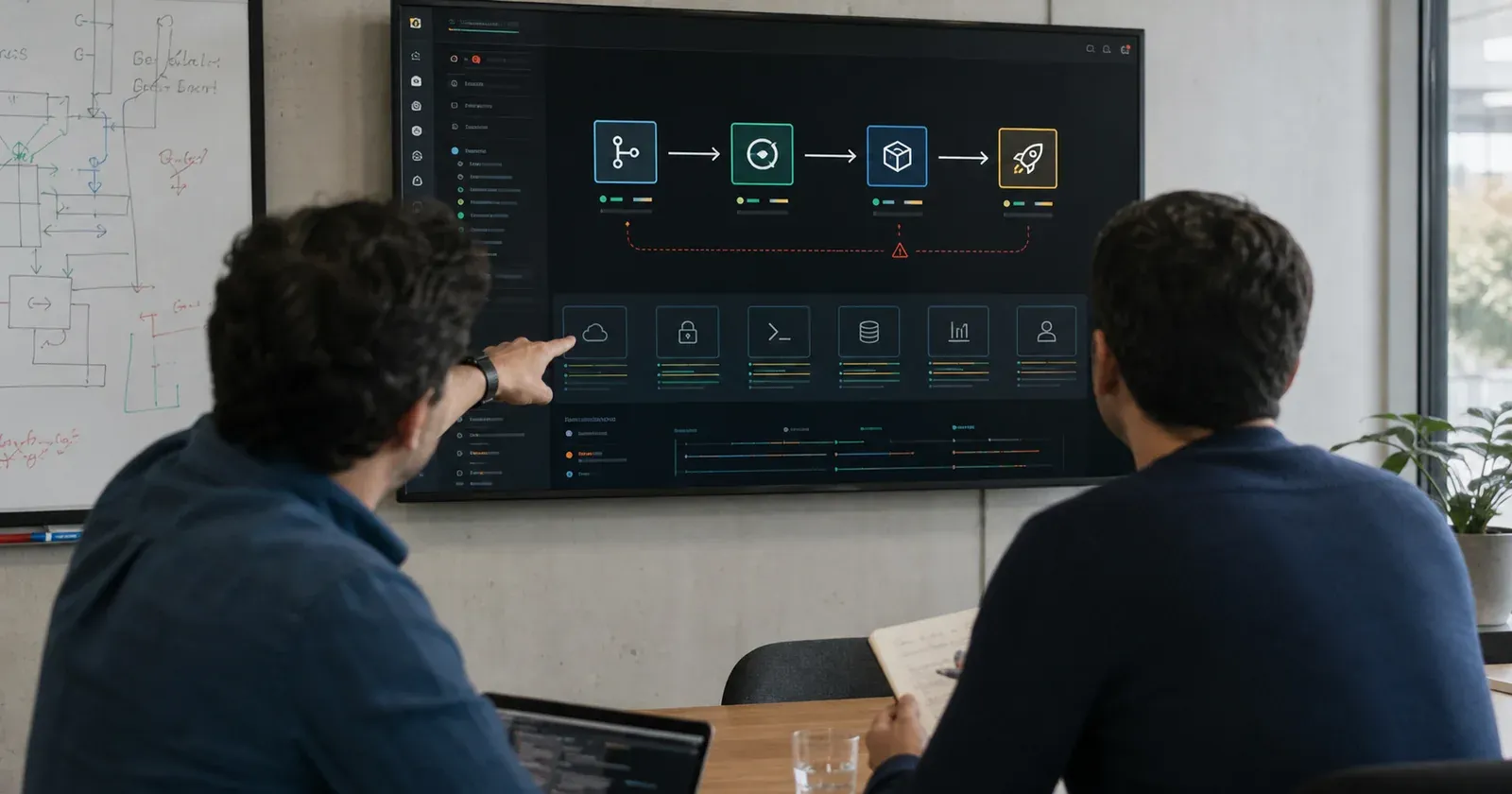
Ask a senior engineer at a growing company how long it takes to ship a new service from an empty repository to production, and watch their face. The honest answer is rarely “an afternoon.” It is “a week, if I can find the right people.” Somewhere between the first commit and the first request served in production sits a gauntlet: a CI pipeline to copy and pray, a Kubernetes manifest nobody fully understands, a secrets store with its own tribal login ritual, three Slack channels, and two tickets that will sit in a queue until someone notices.
None of this is the product. All of it is in the way. Platform engineering is the discipline that takes this gauntlet seriously — as a problem worth an owner, a roadmap, and real engineering — instead of a tax every team pays forever.
The problem: cognitive load nobody signed up for
There are two default responses to this, and both fail in their own way.
The first is ticket-ops: a central operations team owns the infrastructure, and product engineers file tickets to get anything done. Need a database? File a ticket. Need a new environment? File a ticket, wait three days. This centralizes the knowledge, but it also centralizes the bottleneck. The ops team becomes a queue, product teams lose autonomy, and the phrase “I’m blocked on infra” becomes a permanent fixture of standup.
The second is you-build-it-you-run-it taken literally: every team owns its full stack, end to end. This restores autonomy — and detonates cognitive load. Now every team reinvents CI, rediscovers the same Kubernetes footguns, and writes its own subtly-broken Terraform. The organization pays for the same mistakes dozens of times, and its best engineers spend their days on plumbing instead of the product they were hired to build.
The uncomfortable truth is that a platform already exists in both cases. It is just implicit — scattered across wikis, tribal knowledge, and the memory of whoever set things up two years ago. The question was never whether to have a platform. It is whether anyone owns it.
Why it matters
The cost of an unowned platform is not abstract. It shows up as measurable drag:
- Lead time. Weeks from idea to production, most of it spent fighting infrastructure rather than solving the problem.
- Onboarding. New hires take months to become productive because the path to production lives only in people’s heads.
- Inconsistency. Every service handles logging, secrets, and deployment slightly differently, so operating them is a per-service adventure.
- Attrition of focus. Senior engineers — the ones you least want doing undifferentiated plumbing — spend a third of their time on it anyway.
Multiply any of these across fifty engineers and the business impact is no longer subtle. Slow shipping is lost market position. Inconsistent operations is unplanned downtime. Platform engineering matters because these costs compound silently until someone decides to own them.
The mental model: platform as product
Here is the shift that makes everything else make sense.
A platform is not infrastructure you hand to teams. It is a product, and your engineers are its customers.
That single reframing changes how the work is done. Products are not specified by a ticket queue; they are shaped by understanding user needs. Products are adopted because they are genuinely better than the alternative, not mandated. Products have a roadmap, measure their own usage, and treat a confusing interface as a bug. When you treat the internal platform this way, the platform team stops being a gatekeeper and becomes something far more useful: a team whose success is measured by how fast other teams ship.
Core explanation: golden paths and the IDP
Two ideas do most of the work.
The first is the golden path: a paved, opinionated, well-supported route to production for the common case. Not the only way to do something — an escape hatch always exists — but the way that is so smooth most teams happily take it. A golden path for “a new HTTP service” bundles the repository scaffold, the CI pipeline, the deployment config, the observability wiring, and the security defaults into a single, coherent, tested experience. The team fills in business logic; the platform handles the rest.
The second is the Internal Developer Platform (IDP): the product surface through which engineers consume those golden paths. It might be a CLI, a portal like Backstage, a set of templates, or all three. What matters is that it presents a coherent interface over the messy underlying tools — Kubernetes, Terraform, the CI system, the cloud APIs — so an engineer can provision a database or spin up an environment through self-service, without filing a ticket and without needing to understand the layer beneath.
Underneath sits the platform team, run as a product team. It has a product owner. It talks to its users. It measures adoption and lead time. It says no to features that would fragment the platform, and yes to the boring reliability work that keeps trust intact. Its job is not to build infrastructure — it is to make the right thing the easy thing.
DIAGRAM
ComparisonTicket-driven ops vs. platform engineering
| Dimension | Ticket-driven ops | Platform engineering |
|---|---|---|
| How teams get infra | File a ticket, wait | Self-service through the platform |
| Central team’s role | Gatekeeper and queue | Product team serving internal users |
| Knowledge | Concentrated in ops | Encoded into golden paths |
| Bottleneck | The ops queue | Removed — teams move independently |
| Consistency | Enforced by review | Emergent from the paved path |
| Success metric | Tickets closed | How fast other teams ship |
Trade-offs: when not to build a platform
Platform engineering is a response to scale, and applying it before you have scale is its own mistake.
Even at scale, the pattern has failure modes. A platform team that stops listening builds an ivory tower nobody wants and everyone routes around. A platform that becomes mandatory before it becomes good breeds resentment. And a golden path with no escape hatch stops being a path and becomes a cage — the moment a team has a legitimate need the platform does not serve, it must be able to step off without asking permission.
Key takeaways
- Every growing org already has a platform — implicit, scattered, unowned. Platform engineering is the decision to make it explicit and give it an owner.
- The core problem is cognitive load: past a certain size, shipping safely demands more than any one engineer can hold, and both ticket-ops and pure you-build-it-you-run-it fail to solve it.
- The mental model is platform as product: engineers are customers, adoption is earned not mandated, and success is measured by other teams’ velocity.
- The tools are golden paths (paved routes to production) delivered through an Internal Developer Platform (the self-service surface), owned by a platform team run as a product team.
- Don’t build one too early. Below real scale, a platform is overhead. Build it when the pain is repeated, keep listening, and always leave an escape hatch.
The goal was never to build a platform for its own sake. It was to let a fifty-person engineering org ship as fluidly as a five-person one did — by making the safe, consistent, production-ready path also the easiest one to take.
// continue exploring