Article
Software Architecture
Why Event-Driven Architectures Exist
Direct calls between services are simple until they aren't. Event-driven architecture is the answer to a specific failure of tightly coupled systems — here is the problem it actually solves.
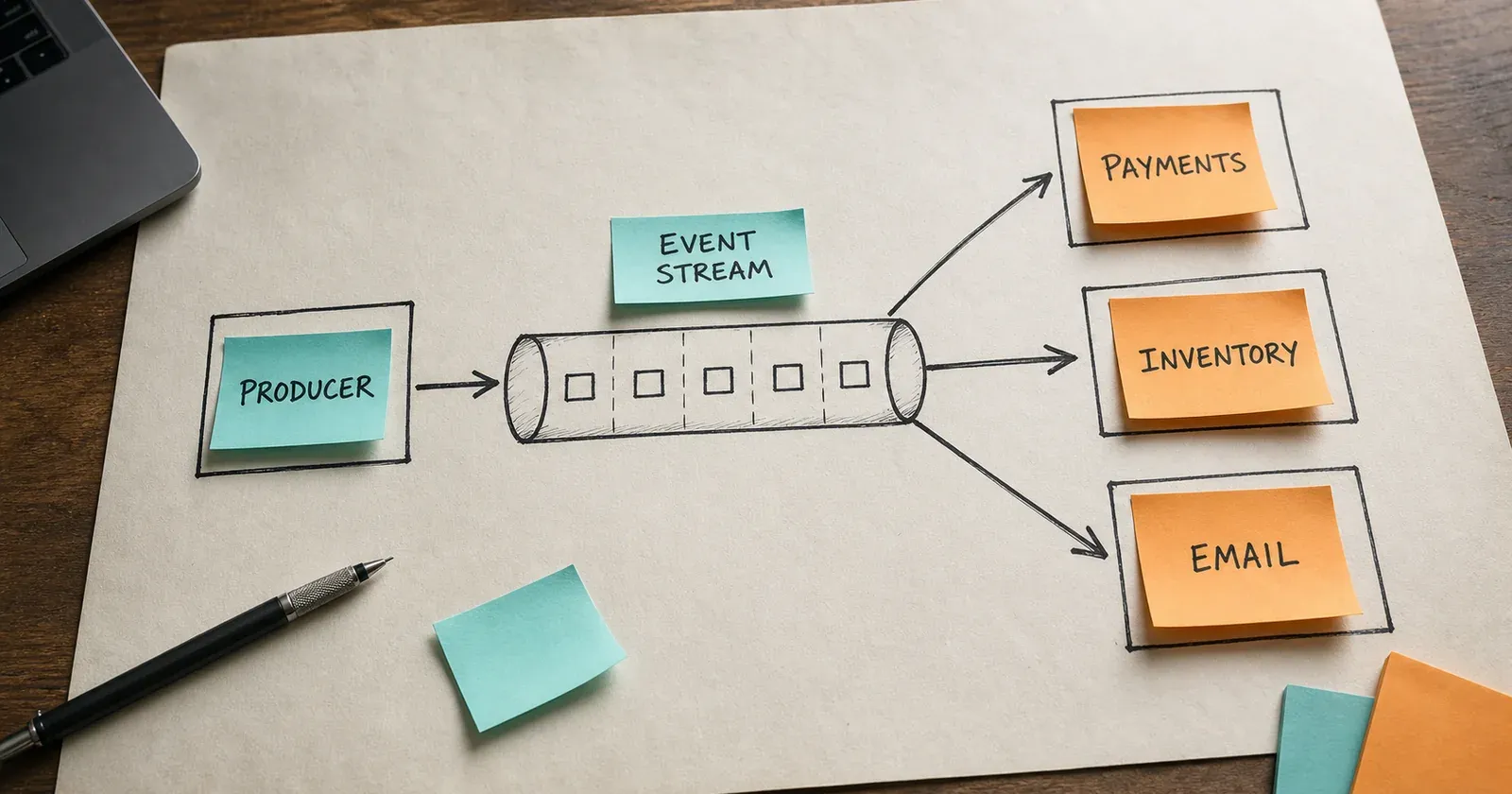
Most systems begin with a single, honest instruction: when this happens, do that. An order is placed, so charge the card, reserve the stock, and send the receipt. Written as direct function calls, it reads like a to-do list. And for a while, it works beautifully.
Then the list grows. Marketing wants a welcome email. Analytics wants the event. Fraud wants a risk score. Each new requirement adds another line inside the same block of code — and the block that once described placing an order slowly becomes the place where the entire company’s logic goes to live.
Event-driven architecture exists to break that gravity.
The problem: coupling that compounds
In a direct-call design, the order service must import, reference, and call every downstream service. It knows the billing API, the inventory API, the email API, and the shape of each one. When any of them changes, the order service changes too. When any of them is slow, the order is slow. When any of them is down, the order fails.
A module should know as little as possible about the rest of the world. Every dependency it holds is a promise it must keep when that dependency changes.
This is coupling, and it compounds. Ten services wired directly to one another produce a web of connections that no single engineer holds in their head. A change becomes a negotiation across teams. The system grows rigid precisely as the business needs it to be flexible.
Why it matters
Coupling is not an aesthetic complaint. It has a cost you can measure:
- Change amplification — one new feature forces edits across many services.
- Failure propagation — a slow dependency becomes everyone’s slowness.
- Deployment friction — services must be released together, in order.
- Cognitive load — no one can reason about a flow without reading all of it.
The teams that feel this most are the ones succeeding: growth is what turns three tidy services into thirty tangled ones.
The mental model: announce, don’t command
The shift is small to describe and large in consequence. Instead of the order service commanding every downstream action, it announces a fact and moves on:
“An order was placed.” — said once, to no one in particular.
Anyone who cares about that fact subscribes to it. Billing reacts. Inventory reacts. Email reacts. The order service does not know they exist, and it does not wait for them. It states what happened; the interested parties decide what to do.
DIAGRAM
Core explanation
Definition
- Event
A statement of fact about something that already happened — emitted once, addressed to no one in particular. An event is named in the past tense (
order.placed), carries the data describing what occurred, and never instructs anyone on what to do about it. The reaction is the subscriber’s decision, not the event’s.
An event-driven system has three roles. A producer emits events. A broker — Kafka, NATS, RabbitMQ, a cloud queue — stores and delivers them. Consumers subscribe and react. The producer and consumer never reference each other; the broker is the only thing they share.
Compare the two shapes directly.
// Command style: the order service owns the whole workflow.async function placeOrder(order: Order): Promise<void> { await billing.charge(order); await inventory.reserve(order); await email.sendReceipt(order); await analytics.track(order); // …and it keeps growing}
// Event style: the order service states a fact and stops.async function placeOrder(order: Order): Promise<void> { await save(order); await events.publish("order.placed", order);}In the second version, adding fraud scoring means writing a new consumer that subscribes to order.placed. The order service is never touched, never redeployed, never even aware. New behavior is added by addition, not by editing — the property that lets large systems keep moving. (Making that save-then-publish reliable when a crash can land between the two is its own problem — the outbox pattern is the standard answer.)
Asynchronous by nature
Because the producer does not wait, work happens in parallel and in the background. The customer gets a confirmation the instant the order is saved; the receipt email is generated a few hundred milliseconds later by a consumer that took its time. A slow email provider no longer slows down checkout, because checkout no longer waits for email.
The broker earns its keep
The broker is not plumbing you tolerate — it is where the guarantees live. It retains events so a consumer that was offline can catch up. It retries delivery when a consumer fails. It lets you add a brand-new consumer that replays months of history to build a fresh view — the same replay-the-log idea at the heart of event sourcing. These capabilities are the actual product of the architecture.
Repositorybitkode/event-driven-playbookRunnable producers, a broker and consumers for every pattern in this article — clone it and watch a single order fan out into billing, inventory and email.Trade-offs
Events are not free, and pretending otherwise is how teams get burned.
ComparisonDirect calls vs. event-driven
| Concern | Direct calls | Event-driven |
|---|---|---|
| Coupling | High — everyone knows all | Low — share only the event |
| Consistency | Immediate | Eventual — reactions lag |
| Debugging a flow | Read one function | Trace across consumers |
| Adding a consumer | Edit the producer | Deploy a new subscriber |
| Failure blast radius | Propagates synchronously | Contained, retried by the broker |
The second cost is observability. A workflow you could once read top to bottom is now scattered across independent consumers. Without correlation IDs and good tracing, “what happened to order 4182?” becomes genuine detective work.
Key takeaways
- Event-driven architecture solves coupling, not speed. Reach for it when change and failure propagation hurt — not by default.
- Producers announce facts; consumers decide how to react. Neither knows the other exists.
- You gain independent evolution and failure isolation; you pay in eventual consistency and harder debugging.
- If your services are few and your consistency needs are strict, a direct call is still the right, honest answer.
The goal was never to use events. The goal was to let each part of a growing system change without asking permission from the rest. Events are simply the most durable way we know to grant that.
// continue exploring